Introduction
When Retrieval Augmented Generation (RAG) burst onto the scene, it felt like a revelation. Suddenly, Large Language Models (LLMs) weren’t just making things up; they could actually consult external knowledge bases, grounding their responses in fact. The core of this magic was often a vector database, storing embeddings of your domain-specific documents. It promised a future where your LLM applications were always accurate, always up-to-date, and free from the dreaded hallucination.
Many of us quickly jumped on board, building proof-of-concepts and even early production systems around this elegant paradigm. You’d embed your documents, push them to a vector store, and then query with your user’s prompt embedding to find relevant chunks. The simplicity was alluring, and for many initial use cases, it delivered. Semantic similarity felt like the holy grail of information retrieval.
But if you’ve been in the trenches building RAG applications for real-world, high-stakes scenarios, you’ve likely encountered a gnawing frustration. Those initial successes start to give way to subtle failures, inexplicable omissions, and an overall brittleness that prevents your RAG system from truly shining. The promise of flawless retrieval begins to crack under the weight of nuanced queries and complex data. You’re about to learn why hybrid search is not just an optimization, but a fundamental necessity for building truly robust and reliable Retrieval Augmented Generation systems.
When Embeddings Fall Short
The initial allure of pure vector search is its semantic prowess. You ask a question like “how do I configure multi-factor authentication for my cloud account?” and the vector database magically pulls up documents about MFA, cloud security, and account settings, even if your query doesn’t contain those exact words. This ability to understand intent, rather than just keywords, is transformative. It’s fantastic for open-ended questions where conceptual similarity is paramount.
However, the real world of data and user queries isn’t always so conceptually fluid. Consider a user asking for a specific error code: “What does error AX2034-FAIL mean in service logs?” Or perhaps they’re looking for a product with a precise SKU: “Find details for product PN-9876-ALPHA.” In these scenarios, pure semantic search can, quite frankly, fail spectacularly.
Why does this happen? Vector database limitations often stem from the nature of embeddings themselves. Embeddings compress a document’s meaning into a dense vector space. While excellent for capturing general semantics, this compression can obscure minute, yet critical, details like exact keywords, IDs, or very specific phrases. The embedding for “error AX2034-FAIL” might be very similar to “error AX2035-FAILURE” if the surrounding text is similar. A slight difference in a code string, which is profoundly different in meaning, can be lost in the embedding’s generalized representation.
This leads to a pervasive problem in production RAG systems: poor recall for precise queries. Your system might return conceptually related documents, but miss the one definitive document containing the exact match. This “needle in a haystack” problem is particularly acute when the “needle” is a unique identifier or a very specific term that doesn’t have much surrounding context to boost its semantic signal. Your users expect precision, especially when they ask for it directly. Relying solely on vector embeddings, while powerful, leaves you vulnerable to these silent failures, making your otherwise intelligent RAG system appear unreliable.
The Hybrid Imperative
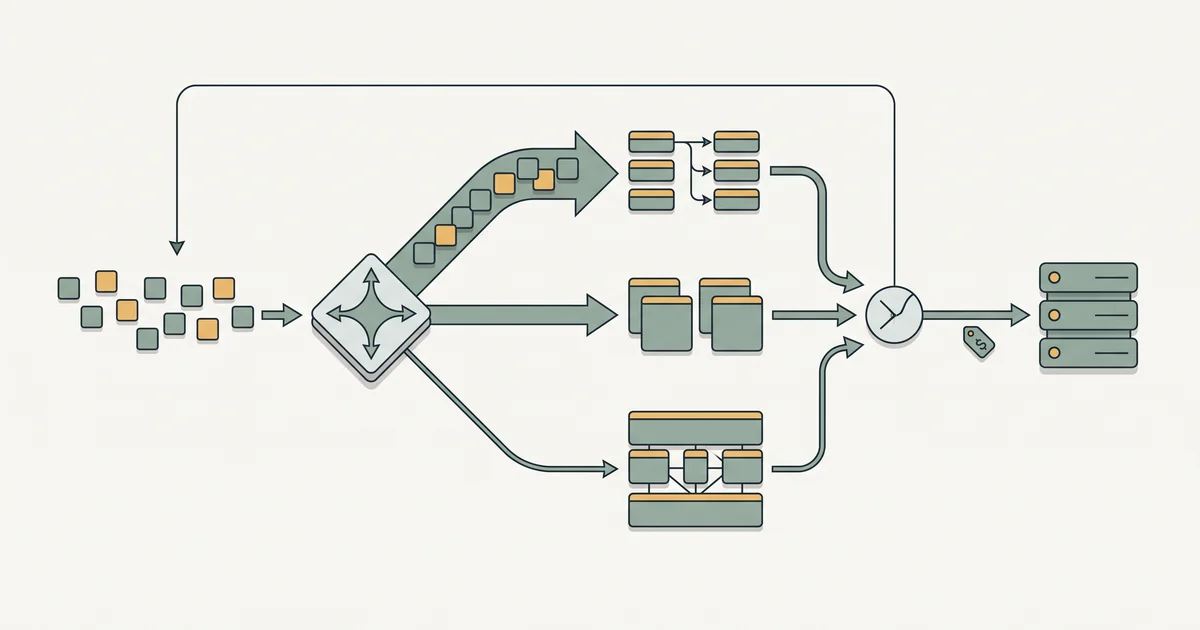
This is where the concept of hybrid search rag enters the picture, not as a nice-to-have, but as a critical architectural component. Hybrid search acknowledges that there isn’t a single “best” way to retrieve information. Instead, it combines multiple retrieval strategies, leveraging the strengths of each to overcome the weaknesses of others. Think of it as a multi-pronged attack on the information retrieval problem.
At its core, hybrid search typically fuses two main approaches:
- Dense Vector Retrieval: This is your familiar semantic search, using embeddings to find documents conceptually similar to the query. It excels at understanding intent and broad topics.
- Sparse Vector Retrieval: This is traditional keyword search, often powered by algorithms like BM25. It excels at finding exact matches, specific terms, and rare keywords that might be semantically distant but directly relevant.
The magic happens when you combine these. When a user asks a question, your system performs both a semantic search and a keyword search in parallel. The results from both pathways are then merged and intelligently re-ranked to produce a final, comprehensive set of relevant documents. This significantly improves both precision (by hitting exact matches) and recall (by covering both semantic and keyword relevance).
Furthermore, for even greater robustness, you can integrate structured metadata into your search. Imagine filtering your documents by author, date, document_type, or specific product_category before or after your vector and keyword searches. This allows you to apply precise constraints to your retrieval, ensuring that the LLM is only ever exposed to truly relevant information. This combination of dense vectors, sparse vectors, and structured filters creates a retrieval system far more resilient and accurate than any single method alone.
This architectural shift is quickly becoming an industry standard. For robust RAG systems, hybrid search that combines dense and sparse vector retrieval is now widely recognized as a necessity for comprehensive and accurate information retrieval. And this isn’t just a theoretical concept. Advanced RAG implementations increasingly rely on pairing BM25 keyword search with vector search to overcome the limitations of embeddings-only retrieval, particularly when dealing with specific and exact matches. Leading RAG frameworks reflect this consensus too, explicitly advising developers to integrate both keyword and semantic search for superior retrieval performance, moving well beyond embeddings alone. The takeaway is clear: to move beyond brittle RAG, you need to move beyond embeddings-only retrieval.
Architecting Your Hybrid RAG Pipeline
Implementing hybrid search might sound daunting, but modern tools and frameworks make it surprisingly accessible. Here’s a practical, actionable approach to building your own hybrid retriever.
Step 1: Prepare Your Data for Multi-Modal Indexing
The first step is to ensure your documents are ready for both semantic and keyword search. This means retaining the original text content, generating embeddings, and extracting any relevant structured metadata.
from sentence_transformers import SentenceTransformer

# Load an embedding model
model = SentenceTransformer('all-MiniLM-L6-v2')

def prepare_document(doc_id, text_content, metadata=None):
    """
    Prepares a document for hybrid indexing.
    Returns: A dictionary with text, embedding, and metadata.
    """
    embedding = model.encode(text_content).tolist()
    document = {
        "id": doc_id,
        "text": text_content,
        "embedding": embedding,
        "metadata": metadata if metadata else {}
    }
    return document

# Example document
doc_data = prepare_document(
    "doc_123",
    "How to troubleshoot error code AX2034-FAIL in our legacy system. Check logs for service 'auth-gateway'.",
    {"category": "troubleshooting", "product": "legacy-system"}
)

# You would then index this 'doc_data' into your chosen hybrid store (e.g., Weaviate, Pinecone, Elasticsearch + vector DB)
print(f"Prepared document with ID: {doc_data['id']}")
print(f"Embedding dimensions: {len(doc_data['embedding'])}")
print(f"Metadata: {doc_data['metadata']}")
You’ll need a storage solution that can handle this. Some vector databases (like Weaviate or Pinecone) offer integrated hybrid capabilities, allowing you to store text, embeddings, and structured metadata together. Alternatively, you might use a combination: an Elasticsearch instance for keyword and metadata search, alongside a dedicated vector database.
Step 2: Implement Dual-Path Querying
When a user submits a query, you’ll run it through both your semantic and keyword search pathways.
def query_hybrid(query_text, embedding_model, vector_store, keyword_store, top_k=10):
    """
    Performs dual-path querying.
    """
    # 1. Semantic Search
    query_embedding = embedding_model.encode(query_text).tolist()
    semantic_results = vector_store.query(query_vector=query_embedding, top_k=top_k)

    # 2. Keyword Search (e.g., using BM25 or simple text search)
    keyword_results = keyword_store.query(query_text=query_text, top_k=top_k)

    # Combine and return raw results for fusion
    return {"semantic": semantic_results, "keyword": keyword_results}

# Placeholder for your actual vector_store and keyword_store implementations
class MockVectorStore:
    def query(self, query_vector, top_k):
        # Simulate results
        return [
            {"id": "doc_456", "score": 0.9, "text": "Related to authentication configuration."},
            {"id": "doc_123", "score": 0.7, "text": "Troubleshooting system errors."},
        ]

class MockKeywordStore:
    def query(self, query_text, top_k):
        # Simulate results based on keyword match
        if "AX2034-FAIL" in query_text:
            return [
                {"id": "doc_123", "score": 0.95, "text": "Details for error code AX2034-FAIL."},
                {"id": "doc_789", "score": 0.8, "text": "Common error codes documentation."},
            ]
        return [{"id": "doc_101", "score": 0.7, "text": "General system information."}]

# Example query
query = "What does error AX2034-FAIL mean?"
embedding_model = SentenceTransformer('all-MiniLM-L6-v2')
vector_store = MockVectorStore()
keyword_store = MockKeywordStore()

raw_results = query_hybrid(query, embedding_model, vector_store, keyword_store)
# print(raw_results)
Step 3: Fuse and Rerank Results
This is where the retrieved documents from both pathways are combined and ranked. A common and effective method is Reciprocal Rank Fusion (RRF). RRF doesn’t require tuning weights and is robust to different scoring scales from your underlying search engines. It assigns a score based on the rank of a document in each list.
def reciprocal_rank_fusion(results_lists, k=60):
    """
    Performs Reciprocal Rank Fusion on multiple lists of ranked results.
    Each item in results_lists is a list of {"id": "doc_id", "score": float}.
    """
    fused_scores = {}
    for results in results_lists:
        for rank, item in enumerate(results):
            doc_id = item['id']
            fused_scores[doc_id] = fused_scores.get(doc_id, 0.0) + 1.0 / (rank + k)

    reranked_results = sorted(
        [(doc_id, score) for doc_id, score in fused_scores.items()],
        key=lambda x: x[1],
        reverse=True
    )
    return reranked_results

# Example fusion
semantic_res = raw_results["semantic"]
keyword_res = raw_results["keyword"]

# Convert to just IDs for RRF for simplicity in this example
# In real-world, you'd carry full document objects or pointers
semantic_doc_ids = [{"id": r["id"]} for r in semantic_res]
keyword_doc_ids = [{"id": r["id"]} for r in keyword_res]

fused_list = reciprocal_rank_fusion([semantic_doc_ids, keyword_doc_ids])
# print(fused_list)
# Example output for 'What does error AX2034-FAIL mean?':
# [('doc_123', 0.03333333333333333), ('doc_456', 0.01639344262295082), ('doc_789', 0.01639344262295082), ('doc_101', 0.01639344262295082)]
The fused list represents the final order of documents to pass to your LLM for generation. This process ensures that documents that appear high in either semantic or keyword search, or both, receive a strong boost, giving your LLM the best possible context. Frameworks like LlamaIndex and LangChain provide built-in hybrid retriever components that abstract much of this complexity, allowing you to focus on tuning and evaluation rather than raw implementation details.
Common Hybrid Search Headaches
While undeniably powerful, hybrid search isn’t a magic bullet that solves all your RAG problems without effort. There are specific challenges and pitfalls you should be aware of as you implement this strategy.
One common mistake is over-reliance on default fusion algorithms. While RRF is a great starting point, it’s not always optimal for every domain or query type. You might find that for some queries, keyword matches are overwhelmingly more important, while for others, semantic relevance holds more weight. Experimentation with different k values in RRF, or even exploring learned fusion models, can yield significant improvements. Don’t assume the out-of-the-box solution is perfectly tuned for your specific use case.
Another pitfall is ignoring metadata entirely. Developers often get caught up in the dense vs. sparse vector debate and forget the power of good old structured data. If your documents have attributes like status, version, author, or date_published, use them! Filtering your search results with metadata can drastically prune irrelevant documents before reranking, leading to much higher precision and reducing the context window burden on your LLM. Forgetting this rich source of information leaves a lot of potential on the table.
Finally, suboptimal chunking strategies can still plague hybrid RAG. For pure semantic search, larger chunks might sometimes be beneficial to capture more context. However, for hybrid search, overly large chunks can dilute the signal of critical keywords. Conversely, very small chunks might fragment the semantic context. You need a chunking strategy that balances both: ensuring enough semantic context for embedding models, but also keeping keyword density high enough within individual chunks for effective sparse retrieval. This often means iterating and testing different chunk sizes and overlaps for your specific dataset.
Next Frontiers: Adaptive and Context-Aware RAG
As you master hybrid search, the journey towards truly intelligent RAG doesn’t end. The next evolution lies in making your retrieval systems even more dynamic and context-aware. Imagine a system that can intelligently decide which retrieval strategy to prioritize based on the nature of the user’s query. Is it a precise, factual lookup demanding keyword accuracy? Or a broad, conceptual question best served by semantic similarity? This is the realm of adaptive RAG.
Adaptive RAG might involve a small, specialized LLM or a classification model analyzing the incoming query to route it through an optimized retrieval pipeline. Perhaps some queries warrant a primary graph-based retrieval, while others are best with a hybrid vector-keyword approach. Beyond just text, the future of RAG is also increasingly multi-modal, incorporating images, audio, and video directly into the knowledge base. Imagine an LLM that can answer questions about a diagram by retrieving similar diagrams and their associated text descriptions. Leveraging knowledge graphs for richer, interconnected context is another powerful avenue, allowing RAG systems to understand relationships between entities, not just their content. These advancements push beyond simple document retrieval, aiming for a deeper, more human-like understanding of information.
The Untapped Potential of Context
The initial excitement around vector databases and semantic search was well-placed; they represented a significant leap forward in our ability to give LLMs access to external knowledge. But like many powerful tools, their limitations became apparent in the demanding crucible of production environments. You’ve seen how relying solely on embeddings, while powerful for conceptual queries, often introduces a frustrating brittleness when precision and exactness are paramount.
The shift to hybrid search isn’t merely an incremental improvement; it’s a fundamental architectural decision that acknowledges the multifaceted nature of information retrieval. By thoughtfully combining semantic understanding with the undeniable power of keyword matching and structured metadata, you create a RAG system that is not only smart but also reliable. This approach ensures your LLM applications can confidently answer both “What does this mean?” and “Tell me about this specific thing,” transforming them from brittle prototypes into production-grade powerhouses. Embrace hybrid search, and unlock the true, untapped potential of context for your LLM applications.