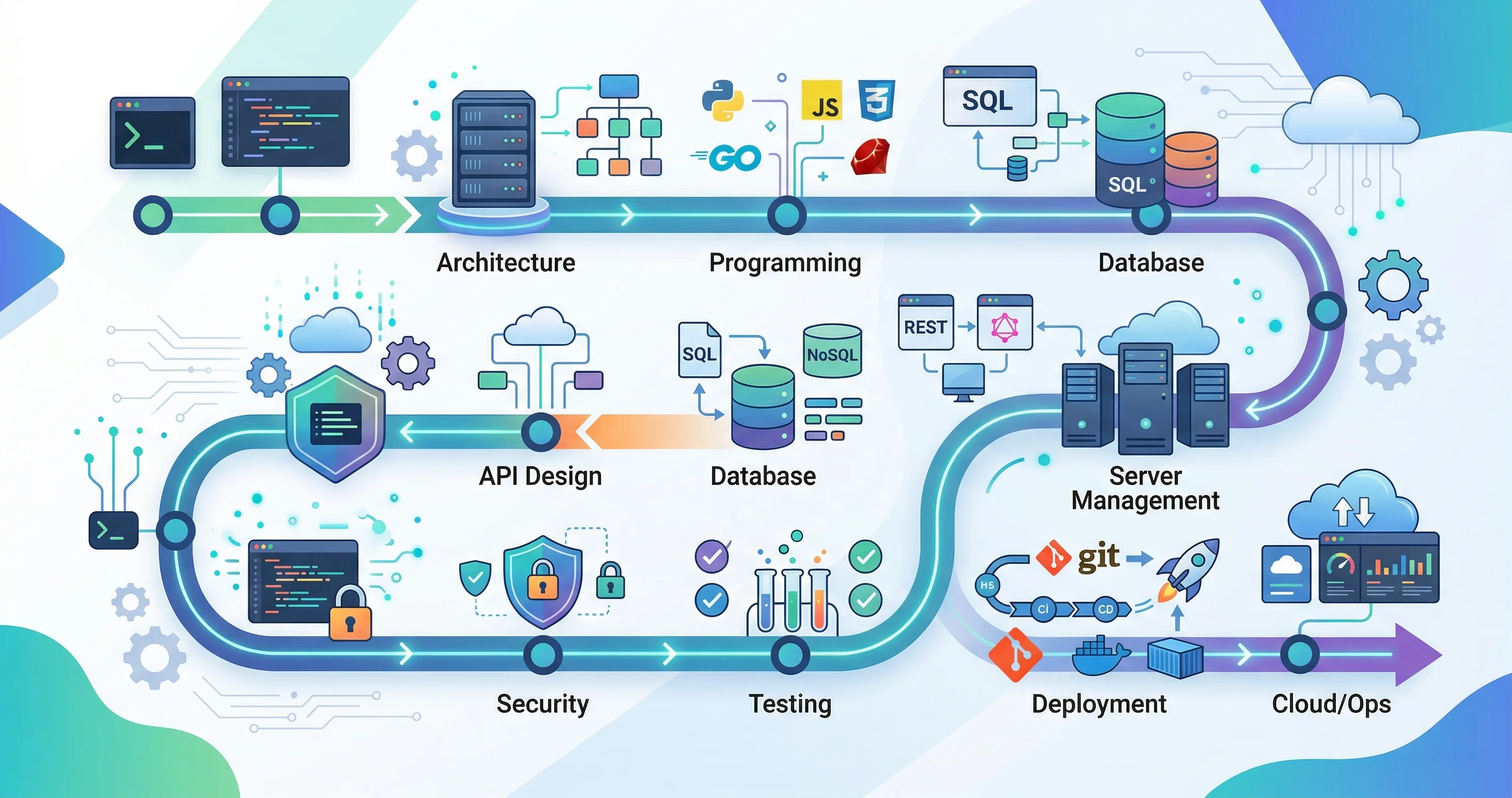
What Is Backend Development?
Backend development is everything that happens on the server — processing requests, storing and retrieving data, authenticating users, and sending responses to the frontend. While users never see it directly, the backend is what makes applications functional, secure, and scalable.
Prerequisites
Before starting the backend path, you should be comfortable with:
- Basic JavaScript or Python syntax
- How HTTP works (requests, responses, status codes)
- The command line and Git
Stage 1: How the Web Works
Before writing a single line of server code, understand the infrastructure it runs on:
- HTTP/HTTPS — Methods (
GET,POST,PUT,DELETE,PATCH), headers, status codes (200, 201, 400, 401, 404, 500) - DNS — How domain names resolve to IP addresses
- Request/response cycle — What happens between a browser request and a server response
- REST principles — Statelessness, resource-based URLs, and uniform interfaces
Stage 2: Your First Server
Pick a language and framework. Node.js with Express is the most beginner-friendly for developers who already know JavaScript:
const express = require("express");
const app = express();

app.use(express.json());

app.get("/api/users", (req, res) => {
  res.json([{ id: 1, name: "Alice" }]);
});

app.listen(3000, () => console.log("Server running on port 3000"));
Learn to handle:
- Route parameters (
/users/:id) - Query strings (
/users?role=admin) - Request bodies (JSON from
POSTandPUTrequests) - Error handling middleware
Stage 3: Databases
Almost every application needs persistent storage. Learn both types:
Relational (SQL) — PostgreSQL:
- Tables, rows, and columns
SELECT,INSERT,UPDATE,DELETE- Joins, indexes, and foreign keys
- When to normalize vs. denormalize data
Non-relational (NoSQL) — MongoDB or Redis:
- Document-based storage
- When NoSQL is the right tool (flexible schemas, caching, sessions)
Learn an ORM (Object-Relational Mapper) like Prisma (Node.js) or SQLAlchemy (Python) to query your database with type safety.
Stage 4: Authentication and Security
Security cannot be an afterthought:
- Password hashing — Always hash passwords with bcrypt or Argon2. Never store plain text.
- JWTs (JSON Web Tokens) — How stateless authentication works in APIs
- Sessions and cookies — When server-side sessions are preferable
- OAuth 2.0 — “Sign in with Google/GitHub” flows
- Common vulnerabilities — SQL injection, XSS, CSRF, and how to prevent them
- Rate limiting — Protect your API from abuse and brute-force attacks
Stage 5: APIs and Architecture
- RESTful API design — Consistent naming, versioning (
/api/v1/), and pagination - Validation — Validate all input server-side using libraries like Zod or Joi
- GraphQL — An alternative to REST with flexible querying (learn after REST)
- Microservices — How to break a monolith into smaller services (advanced)
Stage 6: Deployment and Infrastructure
- Environment variables — Keep secrets out of your code
- Docker — Containerize your application for consistent deployments
- CI/CD — Automate testing and deployment with GitHub Actions
- Cloud platforms — Render, Railway, or Fly.io for simple deployments; AWS/GCP for enterprise scale
- Monitoring — Application logs, error tracking (Sentry), and uptime monitoring
Milestones That Prove Progress
Backend learning becomes real when you can design an API, persist data, protect routes, and debug production-like failures. Start with a single service and one database. Avoid jumping into microservices before you can explain request flow, transactions, indexes, authentication, and deployment.
A good first milestone is a CRUD API with validation and clear error responses. The next milestone is authentication: registration, login, password hashing, token/session handling, and protected routes. After that, add background jobs, file uploads, rate limits, and observability.
Project Sequence
Build projects that force you to handle real backend concerns:
- A notes or bookmark API with CRUD and validation.
- A user-authenticated app with password reset.
- A job queue that processes slow work outside the request cycle.
- An API with pagination, filtering, and database indexes.
- A deployed service with logs, health checks, tests, and CI.
For each project, document the data model and API contract before writing all the handlers. That habit prevents endpoints from growing randomly as the project evolves.
Common Roadmap Mistakes
The biggest mistake is treating backend development as only “write endpoints.” Production backend work includes data integrity, failure handling, deployment, secrets, migrations, monitoring, and security. If the database schema is poor, the API will eventually reflect that pain.
Another mistake is ignoring tests until the app is large. Start with unit tests for pure logic and integration tests for important API routes. You do not need perfect coverage, but you do need confidence that authentication, permissions, and data writes behave correctly.
What I Would Do In Practice
I would learn one backend stack deeply before sampling many. Pick Node, Python, Go, Java, or C# and build enough with it to understand the full lifecycle: local dev, tests, migrations, deployment, logging, and rollback.
The goal is not just to make a server respond. The goal is to build systems that preserve data, fail clearly, and can be operated by someone other than the original author.
Recommended Learning Order
- Build a simple REST API with in-memory data
- Connect it to a PostgreSQL database
- Add user registration and JWT authentication
- Deploy it to a cloud provider
- Add tests and CI/CD
Backend development rewards deliberate practice — build real projects and deploy them publicly to solidify your skills.